AC Voltage and Current Equations
Summary of the Contents (Link to the full posting via the link above or at the bottom of this section)
A three-phase power generator creates electricity by
- rotating a powerful magnet (the rotor)
- inside a stationary frame containing three separate sets of wire coils (the stator),
- each spaced 120 degrees apart .
Picture: Simplified Three Phase AC Generator
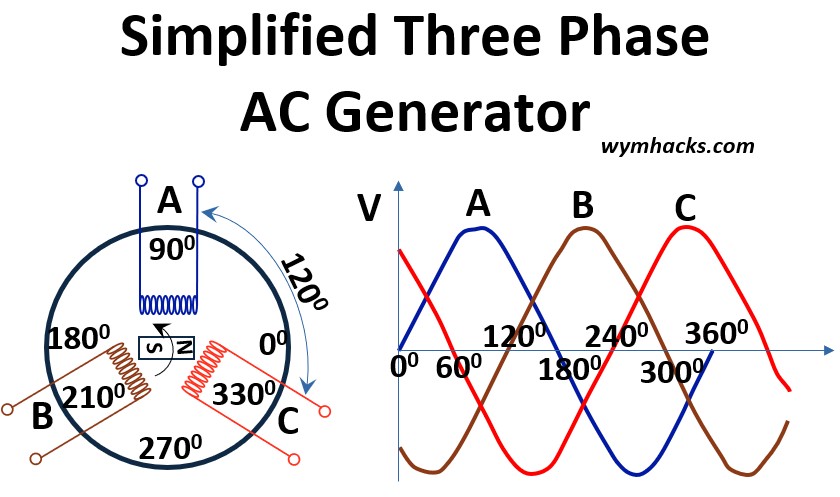
As the magnet spins, its magnetic field sweeps across the coils, inducing a voltage in each one, a principle known as electromagnetic induction.
Because the coils are physically spaced 120 degrees apart, the voltage waveform produced in each coil is also out of phase by 120 degrees from the others.
This process simultaneously generates three distinct AC voltages of the same frequency and amplitude, which are then transmitted to produce the highly efficient and constant power delivery characteristic of three-phase power .
To fully understand the precise relationship between the spinning magnet and the generated electricity, this article derives the mathematical equation that formally defines the periodic, sinusoidal shape of each of these three voltage waveforms.
This equation is essential for modeling and analyzing all aspects of AC power generation.
Please access the article through this link → AC Voltage and Current Equations
AC Circuits: I-V Relationships, Impedance, Admittance, and Power
Summary of the Contents (Link to the full posting via the link above or at the bottom of this section)
This article explains Alternating Current (AC) circuit fundamentals, beginning with the distinct i-v relationships of simple resistor (R), inductor (L), and capacitor (C) circuits.
We establish the mathematical foundation for each element in the time domain, detailing how resistors dissipate energy while inductors and capacitors store and release it through magnetic and electric fields.
Pictures: Simple (Pure) Resistor, Inductor, and Capacitor AC Circuits
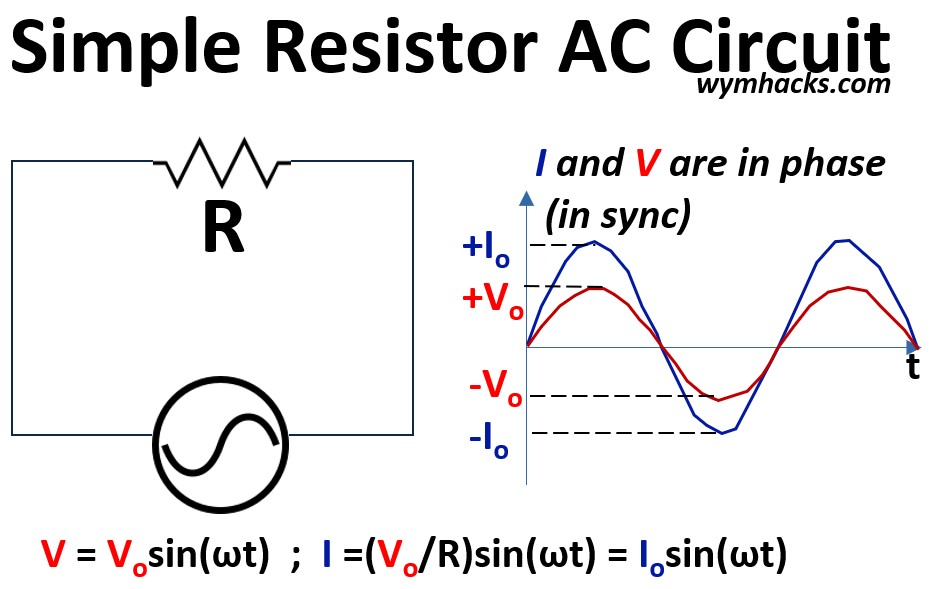
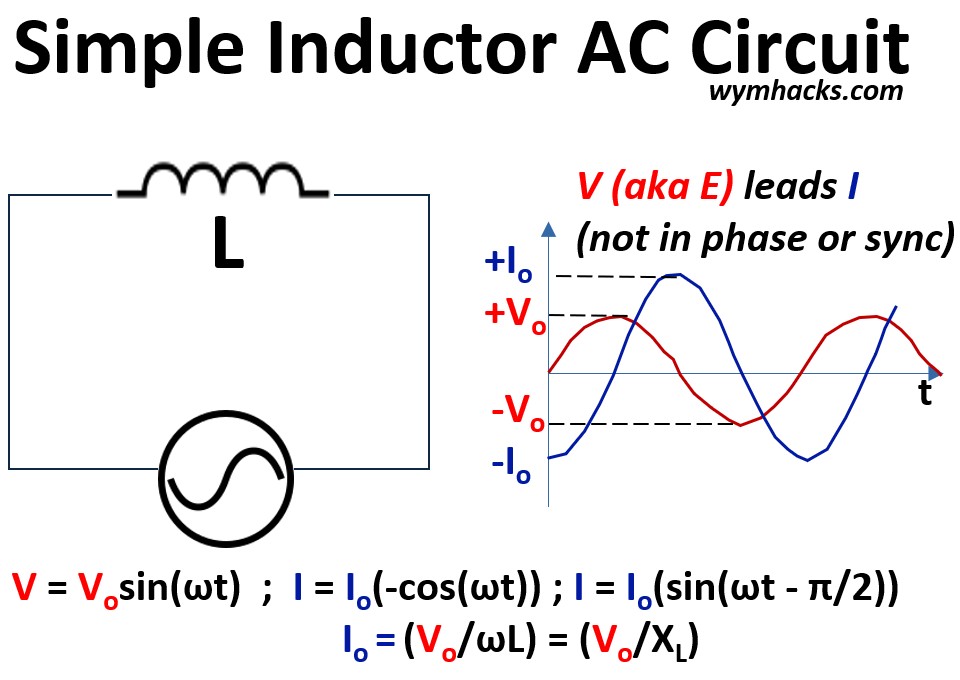
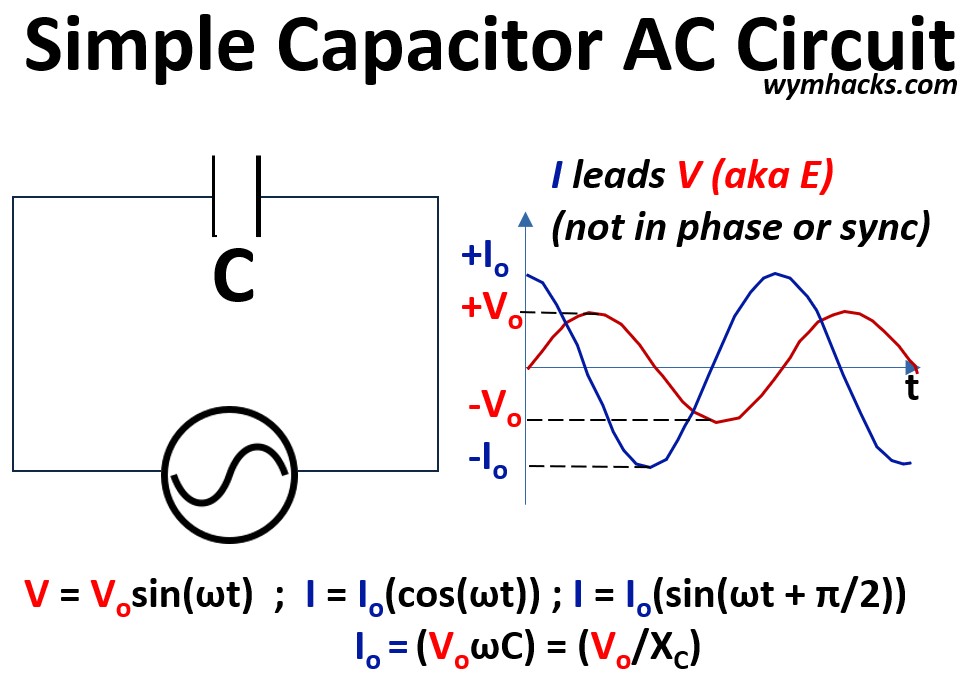
We address the phase shifts inherent to reactive components—where current lags voltage in inductors and leads in capacitors—utilizing the “ELI the ICE man” mnemonic for clarity.
To simplify the analysis of time-varying signals, the guide transitions from time-domain equations to frequency domain equations.
Using Euler’s formula, we introduce phasors and the concept of complex impedance (Z) and admittance (Y).
This transformation allows for the treatment of sinusoidal voltages and currents as rotating vectors, turning complex differential equations into manageable algebraic operations.
The final sections apply these tools to combined RLC circuits in both series and parallel configurations.
Picture: Series and Parallel RLC AC Circuits
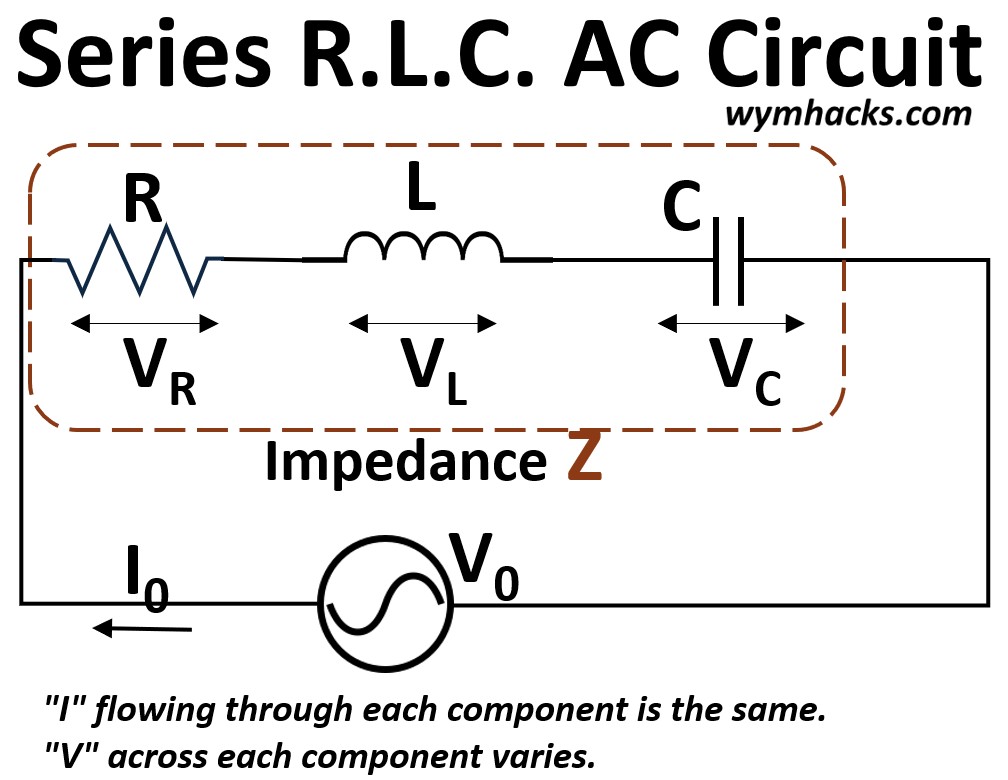
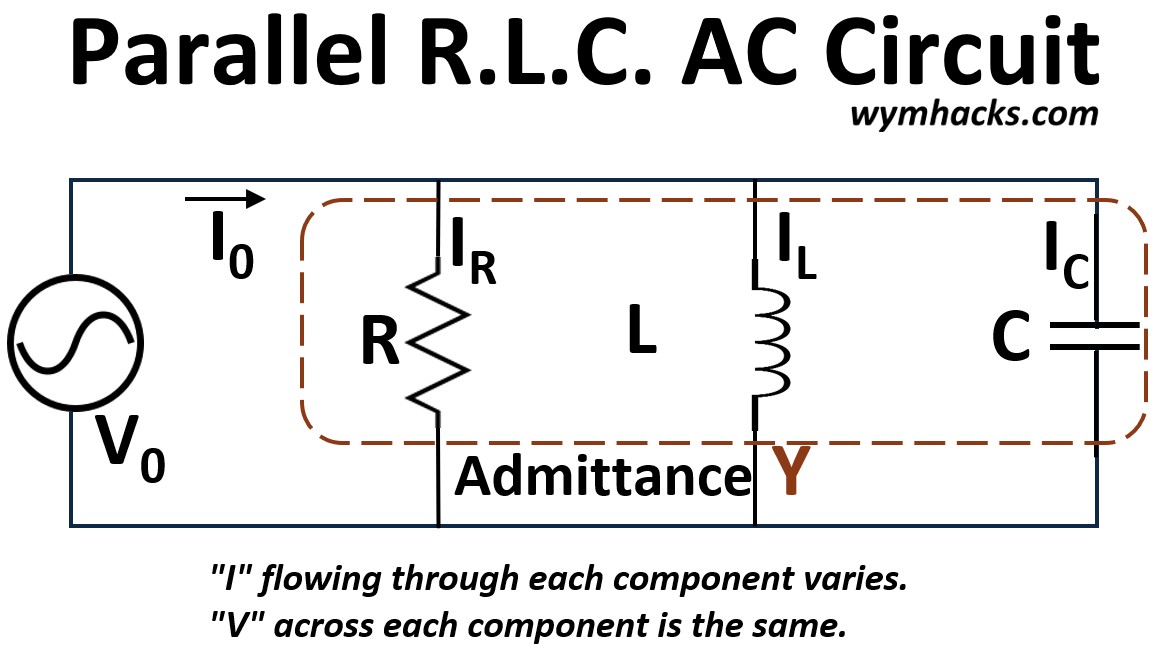
We derive the total circuit response using vector addition, illustrated through voltage, impedance, and power triangles.
Detailed summary tables are provided to bridge the gap between theoretical equations and practical circuit behavior, ensuring a complete understanding of how real power and reactance interact within a system.
Please access the full article through this link → AC Circuits: I-V Relationships, Impedance, Admittance, and Power
Electrical Power Equations
Summary of the Contents (Link to the full posting via the link above or at the bottom of this section)
This post provides a technical breakdown of electrical power, moving from fundamental DC theory to complex three-phase systems.
We begin with the derivation of power equations from Ohm’s Law and progress through the mathematical origins of single-phase and balanced three-phase AC power.
After establishing these algebraic foundations, the focus shifts to the geometric and physical reality of the power triangle.
Picture: Power Triangle: Balanced 3 Phase AC System
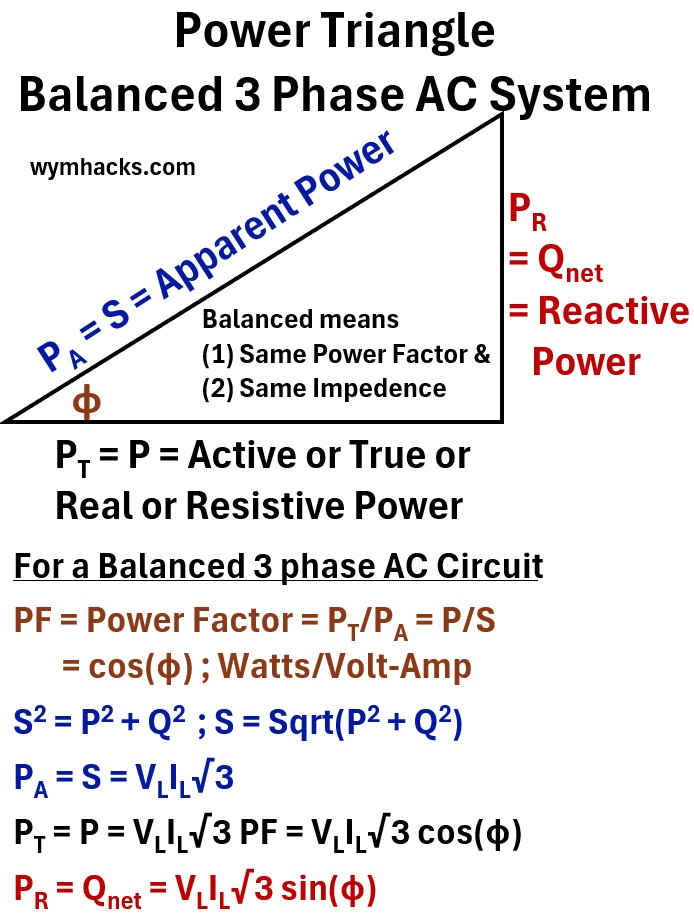
We distinguish between active, reactive, and apparent power—using both the traditional “Beer Analogy” and the more physically accurate “Horse and Railcar” model—before concluding with the methodology required to calculate power in unbalanced systems where standard symmetry fails.