NFL Football Conferences, Divisions, and Teams (and Reasons for the Names)
The NFL has two conferences (NFC and AFC) with each conference containing four team divisions.
So, we have a total of 32 teams.
Team Tabulation
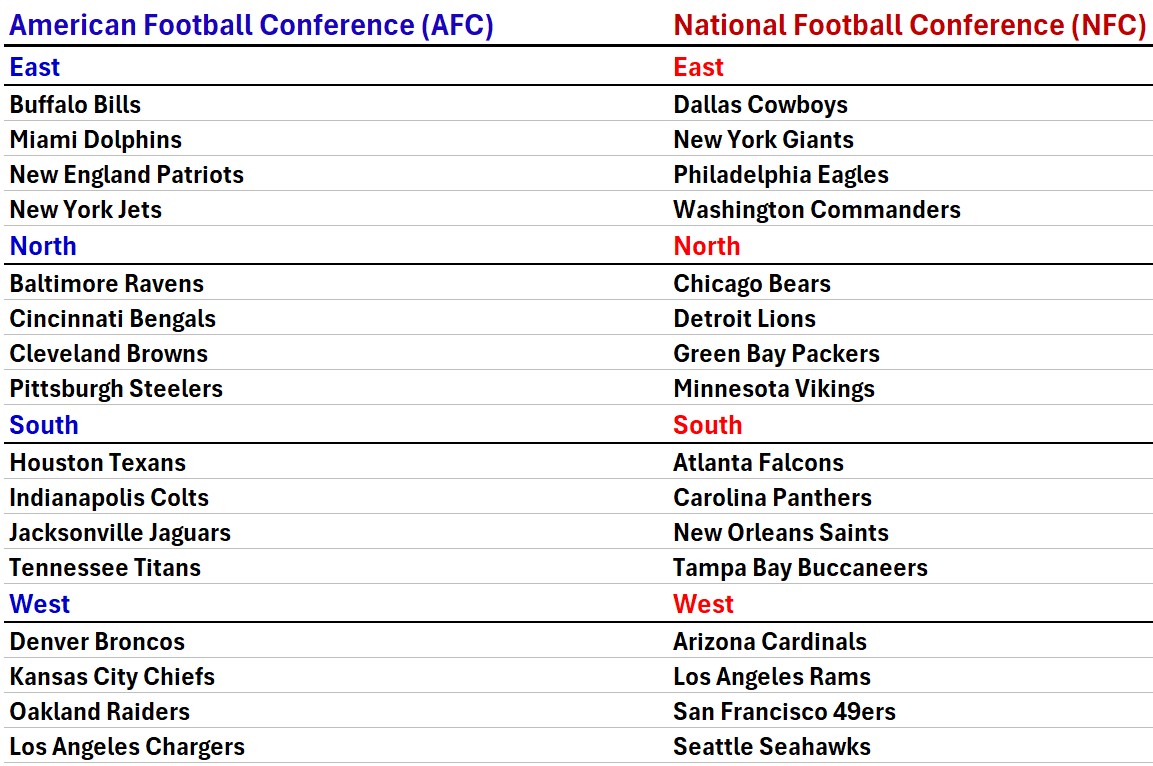
Table: AFC and NFC NFL Teams
American Football Conference (AFC)
East
Buffalo Bills
Miami Dolphins
New England Patriots
New York Jets
North
Baltimore Ravens
Cincinnati Bengals
Cleveland Browns
Pittsburgh Steelers
South
Houston Texans
Indianapolis Colts
Jacksonville Jaguars
Tennessee Titans
West
Denver Broncos
Kansas City Chiefs
Oakland Raiders
Los Angeles Chargers
National Football Conference (NFC)
East
Dallas Cowboys
New York Giants
Philadelphia Eagles
Washington Commanders
North
Chicago Bears
Detroit Lions
Green Bay Packers
Minnesota Vikings
South
Atlanta Falcons
Carolina Panthers
New Orleans Saints
Tampa Bay Buccaneers
West
Arizona Cardinals
Los Angeles Rams
San Francisco 49ers
Seattle Seahawks
Reasons for the Team Names
Here are some backgrounds on the 32 NFL team Names (from Google Gemini).
I’ve arbitrarily bolded some of the interesting ones (to me) in brown.
AFC_East
- Buffalo Bills: Named after frontiersman Buffalo Bill Cody in a fan contest.
- Miami Dolphins: Chosen in a fan contest to reflect the marine animal life and the environment of South Florida.
- New England Patriots: Selected in a fan contest to honor the Revolutionary War history of the region.
- New York Jets: Named to reflect their proximity to LaGuardia Airport and the jet age.
AFC_North
- Baltimore Ravens: Honors the famous poem “The Raven” by Edgar Allan Poe, who lived and died in Baltimore.
- Cincinnati Bengals: Named after the striped Bengal tiger and a former Cincinnati professional football team.
- Cleveland Browns: Named after their legendary first coach and co-founder, Paul Brown.
- Pittsburgh Steelers: Honors the steel-making industry that is central to the city’s economy and history.
AFC_South
- Houston Texans: Chosen in a fan contest to represent the pride and independent spirit of the state of Texas.
- Indianapolis Colts: Inherited the name from the original Baltimore Colts, honoring the history of horse breeding/racing.
- Jacksonville Jaguars: Selected in a fan contest to highlight the largest cat native to the Western Hemisphere (found in Central/South America, but locally relevant).
- Tennessee Titans: Chosen to symbolize the strength, power, and Greek heritage of the name.
AFC_West
- Denver Broncos: Chosen in a fan contest, it refers to the wild horses common in the West.
- Kansas City Chiefs: Named to honor former Kansas City mayor H. Roe Bartle, who had the nickname “Chief.”
- Las Vegas Raiders: The original name was chosen to reflect a swashbuckling, aggressive image.
- Los Angeles Chargers: Original owner Barron Hilton liked the enthusiastic cry of “Charge!” heard at USC games.
NFC_East
- Dallas Cowboys: Chosen to evoke the Western heritage and rugged individualism associated with Texas.
- New York Giants: Adopted the name from the city’s famous New York Giants baseball team upon the football team’s founding.
- Philadelphia Eagles: Chosen to honor the Blue Eagle symbol used by President Franklin D. Roosevelt’s National Recovery Administration.
- Washington Commanders: A name change chosen to honor the military and leadership heritage of the Washington, D.C. area.
NFC_North
- Chicago Bears: Chosen because they shared a stadium with baseball’s Chicago Cubs, and football players were bigger.
- The Chicago Bears are called the Bears because owner George Halas wanted a tougher name than the Chicago Cubs, with whom they shared Wrigley Field, reasoning football players were bigger and stronger than baseball players, adopting the “Bears” name in 1922 as a nod to the Cubs’ “Cubs”.
- The team, originally the Decatur Staleys, moved to Chicago and adopted the iconic orange and blue colors from Halas’s alma mater, the University of Illinois.
- Detroit Lions: Chosen to honor the majesty and power of the lion, similar to baseball’s Detroit Tigers.
- Green Bay Packers: Named after their original sponsor, the Indian Packing Company, who provided funds for uniforms.
- Minnesota Vikings: Chosen to honor the Scandinavian heritage and robust culture of the region.
NFC_South
- Atlanta Falcons: Chosen in a fan contest, citing the bird’s courage, dignity, and fighting spirit.
- Carolina Panthers: Chosen to reflect the state colors (black, blue, silver) and a sleek, powerful animal.
- New Orleans Saints: Selected because the team was founded on All Saints’ Day (November 1st) in a city with a strong Catholic background.
- Tampa Bay Buccaneers: Chosen to evoke the pirate and swashbuckling history associated with the Florida coast.
NFC_West
- Arizona Cardinals: Named because the team’s founder bought used jerseys that were a faded “Cardinal red.”
- Los Angeles Rams: Named to honor the ** Fordham Rams**, a prominent college team at the time of the franchise’s founding.
- Cleveland Roots (1936): The franchise was founded in 1936 as the Cleveland Rams and joined the NFL in 1937.
- College Inspiration: Name based on Team’s first general manager who was a big fan of the Fordham University Rams football team, which was one of the nation’s premier college teams in the 1930s (and featured future NFL legend Vince Lombardi).
- Moved to Los Angeles in 1946, becoming the first professional sports team in California.
- Relocated to St. Louis before returning to L.A.
- San Francisco 49ers: Honors the gold prospectors who arrived during the 1849 California Gold Rush.
- Seattle Seahawks: Chosen in a public naming contest, the name refers to the local Osprey bird of prey.
Team Locations and Associated Divisions
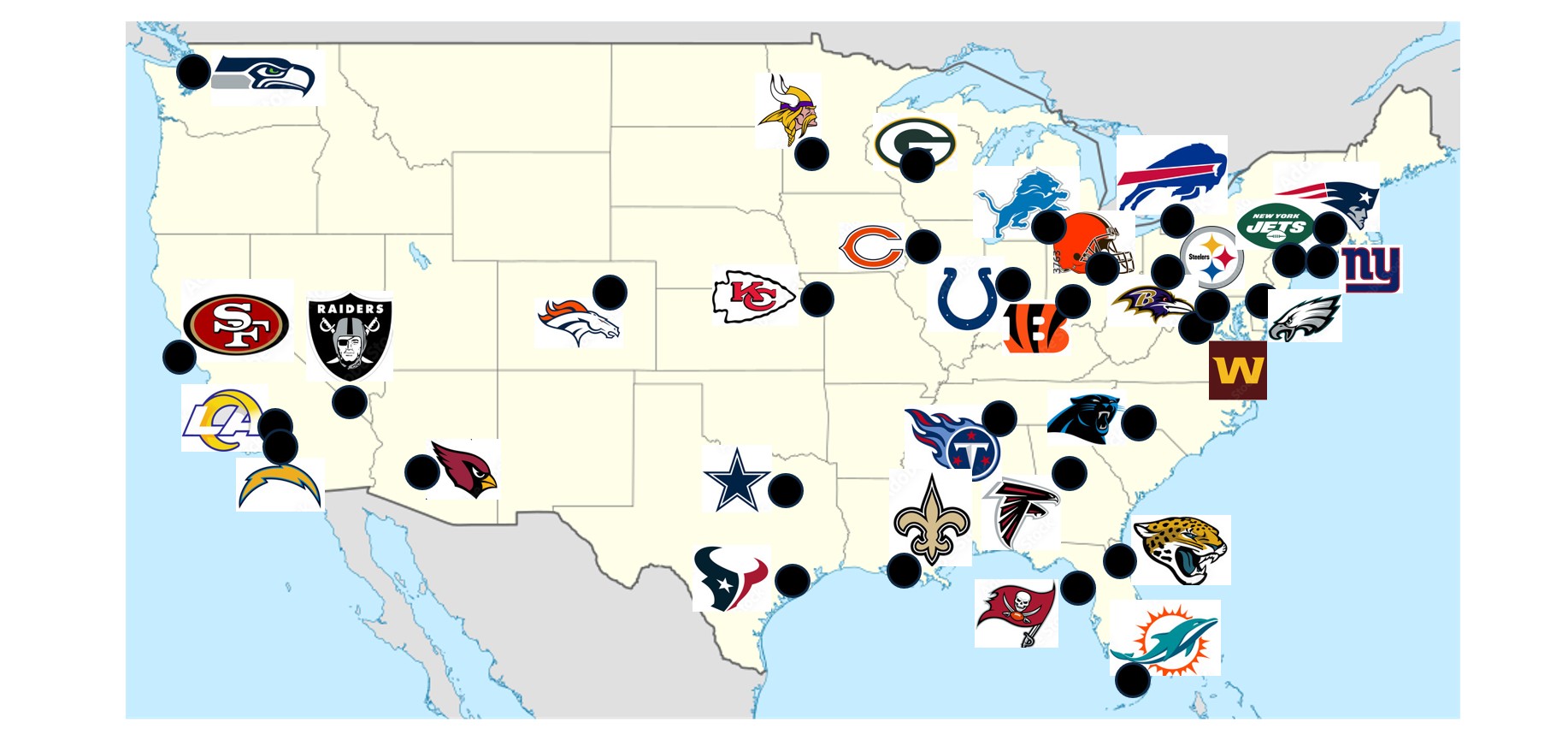
Here are the teams located on a map.
The divisions don’t always follow geographic logic.
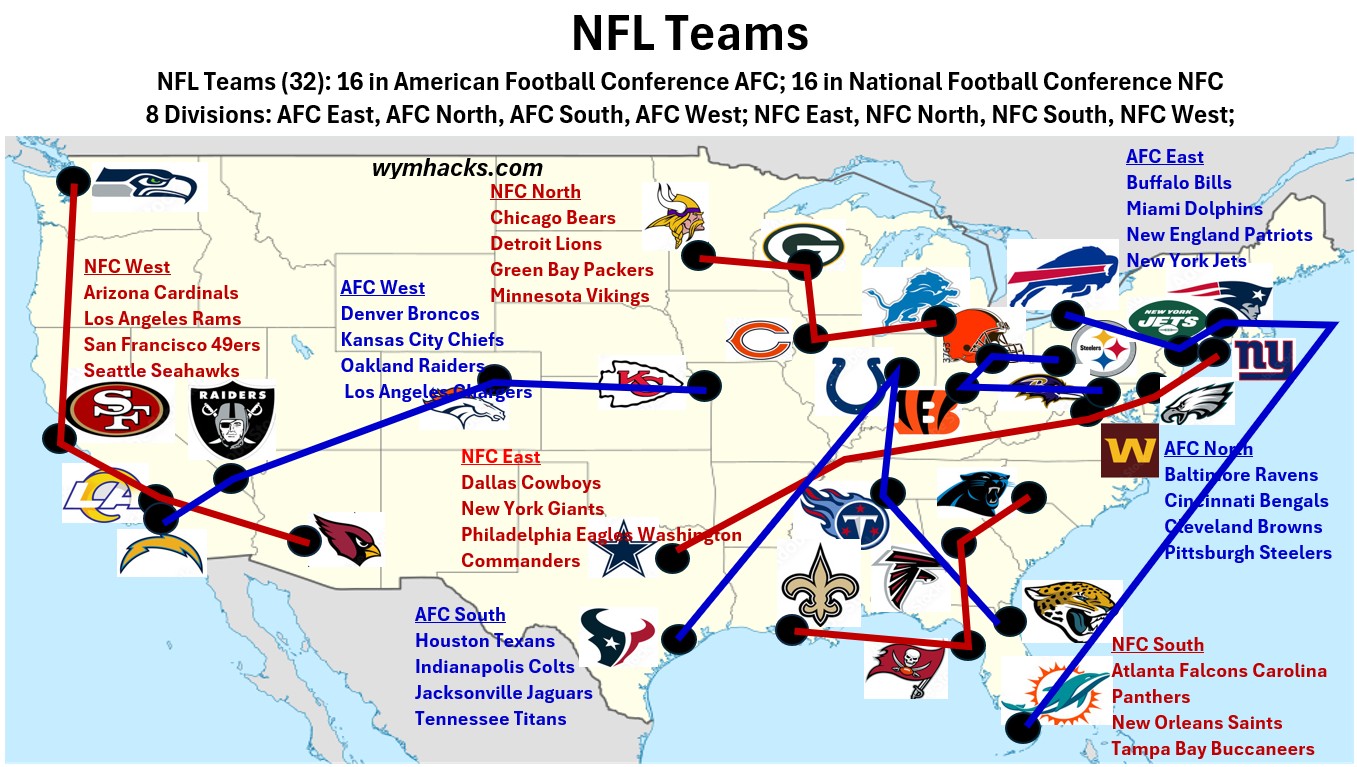
According to data from Google Gemini, the primary reason NFL divisions don’t always make strict geographic sense comes down to History, Rivalries, and Money.
- Preserving Historic Rivalries:
- The league prioritizes guaranteeing that classic, high-rated rivalries—like the Dallas Cowboys vs. the East Coast teams (Giants, Eagles, Commanders) or
- the Buffalo Bills vs. the Miami Dolphins—play each other twice a year.
- Breaking up these fan-favorite pairings to achieve perfect geography would sacrifice guaranteed revenue and fan engagement.
- The 1970 Merger: The structure was largely set after the merger of the old NFL and the rival AFL.
- The league prioritized keeping the AFL teams mostly in the new AFC, and
- the old NFL teams mostly in the NFC.
- This organizational need, more than proximity, set the initial, long-lasting boundaries.
- Relocation and Expansion: Teams have moved over the decades (Colts, Raiders, Rams), but they often keep their original division for competitive or rivalry reasons, even if the city is now distant
- e.g., the Indianapolis Colts remain in the AFC South, which made more sense when they were the Baltimore Colts in the AFC East.
In short, the divisions are a compromise between minor geographic consistency and the overriding need to preserve tradition and maximize television ratings.
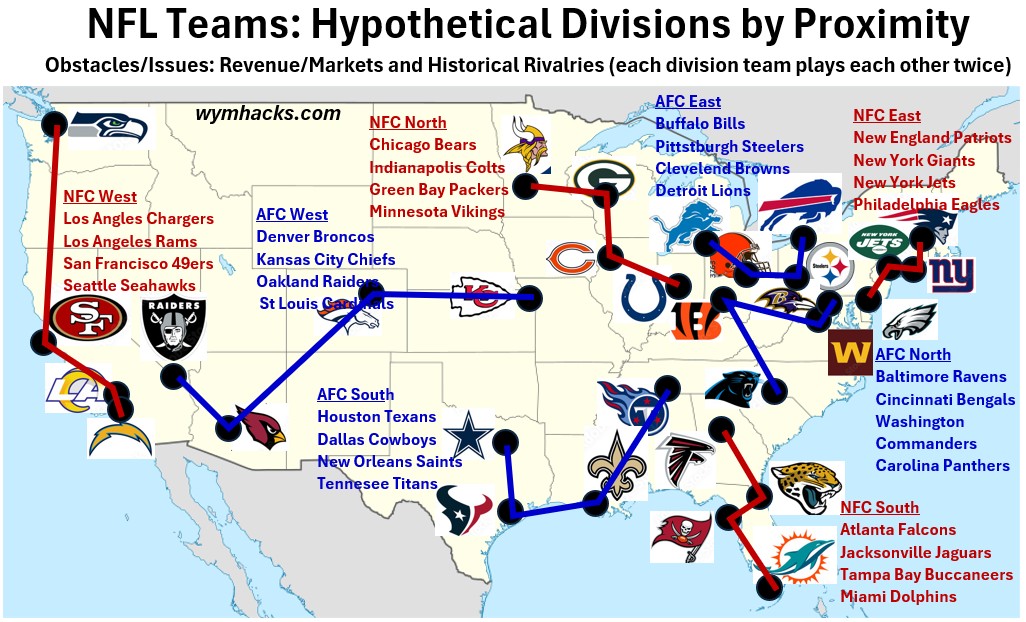
NFL Teams: Hypothetical Divisions
For all the reasons given in the previous section, we don’t have 100% logic on proximity and divisions.
I just make a hypothetical map of what a more geographically consistent division breakdown might look like.
One argument to do something like this would be reducing the environmental footprint due to reduced team travel.
But since the NFL shares revenues, they of course want to maximize revenues
The fear of possible revenue reduction due to Re-divisioning probably scares owners away from this option.
Picture: NFL Teams: Hypothetical Divisions by Proximity