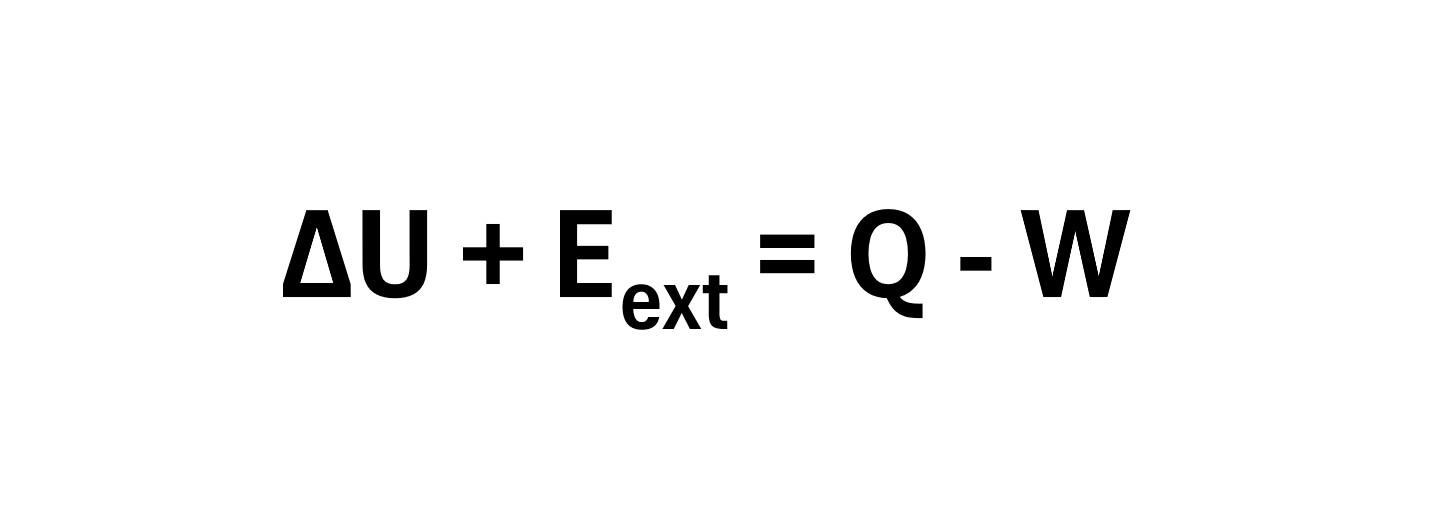
Internal Energy (U)
- The system is where the process occurs and
- everything not in the system is in the surroundings.
Picture: Internal Energy (U) Components
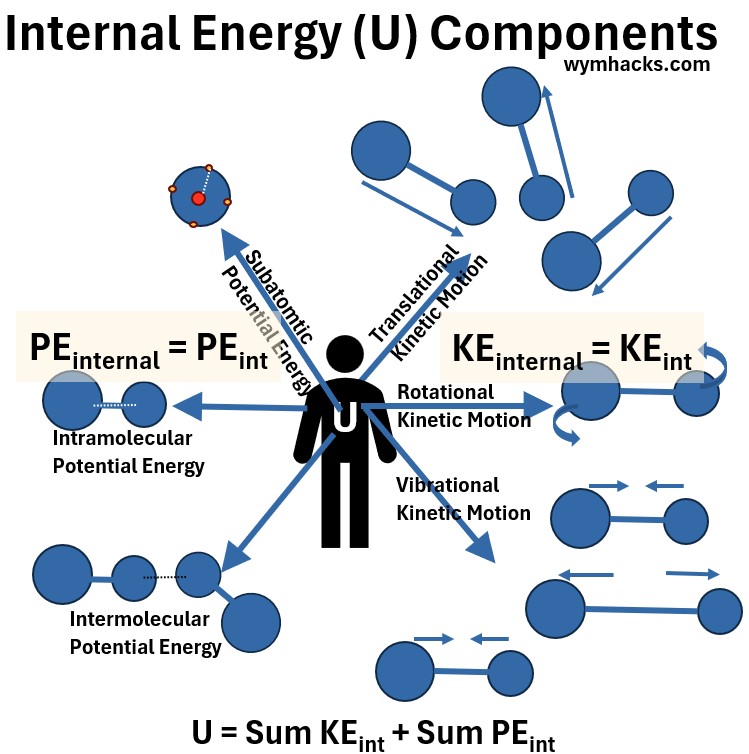
- the bulk motion of molecules (Translational) or
- the rotational movement of molecules (Rotational) or
- the vibrational movement of molecules (Vibrational).
- the Temperature of a substance is a measurements of these kinetic energies.
- atomic nuclear binding forces
- atomic attractive forces inside (within) the molecules (Intramolecular)
- atomic attractive forces among or between the molecules(Intermolecular)
We can define U in equation form as
(14) U = ΣKEint +ΣPEint
- U = the total Internal Energy; has units of energy e.g. joules (J)
- ΣKEint = sum of all Kinetic Energies of the atoms and molecules
- The Temperature of a material indicates its level of kinetic energy.
- ΣPEint = sum of all Potential Energies of the atoms and molecules
A few important characteristics of U are:
- It is a property of the body at
- any instance in time (instantaneous).
- U is therefore a State (or Point) Function.
External Energy of a System
We want to ensure we’ve identified all the energies associated with a system.
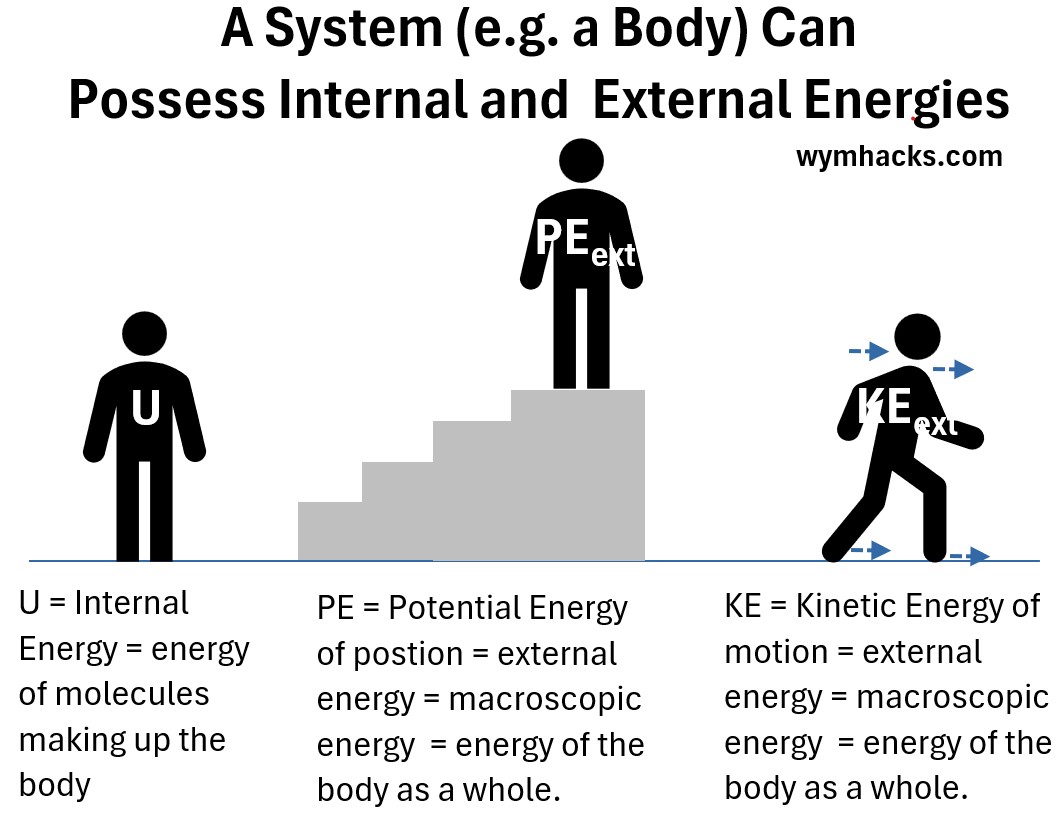
Any process (or body or substance etc.) as a whole (i.e. on a macroscopic or bulk scale) will possess
- Kinetic Energy if it is moving relative to a reference point
- Potential Energy if is configured or positioned differently than a reference point
These are the same concepts as discussed for internal energy but in this case they are being applied to the system as a whole (macroscopically)
So we can comprehensively define the energy of a system by adding up all its Internal and External energies.
Picture: A System Can Possess both Internal and External Energies
The total energy of a system in equation form is:
(15) Etot = U + Eext
(16) Etot = U + Eext (whoops, ignore this line, it’s redundant with above)
(17) Etot = ΣKEint + ΣPEint + KEext + PEext
- In units of energy (Joules in the SI system)
- E tot = Total energy of a substance/object/body
- U = the total Internal Energy
- ΣKEint = sum of all Kinetic Energies of the atoms and molecules (internal)
- ΣPEint = sum of all Potential Energies of the atoms and molecules (internal)
- KEext = kinetic energy of the system as a whole (bulk, external)
- PEext = potential energy of the system as a whole (bulk, external)
And just like U, all the other terms above are also an instantaneous properties of the system.
1st Law of Thermodynamics for A Closed System
- the total quantity of energy is constant, and
- when energy disappears in one form,
- it appears simultaneously in other forms
Consider a system represented by the black box in the picture below.
- Assume the system is closed meaning the mass is constant (no flow of mass across the boundary).
- Assume a finite change to the systems energy has occurred.
Picture: First Law of Thermodynamics – Closed System
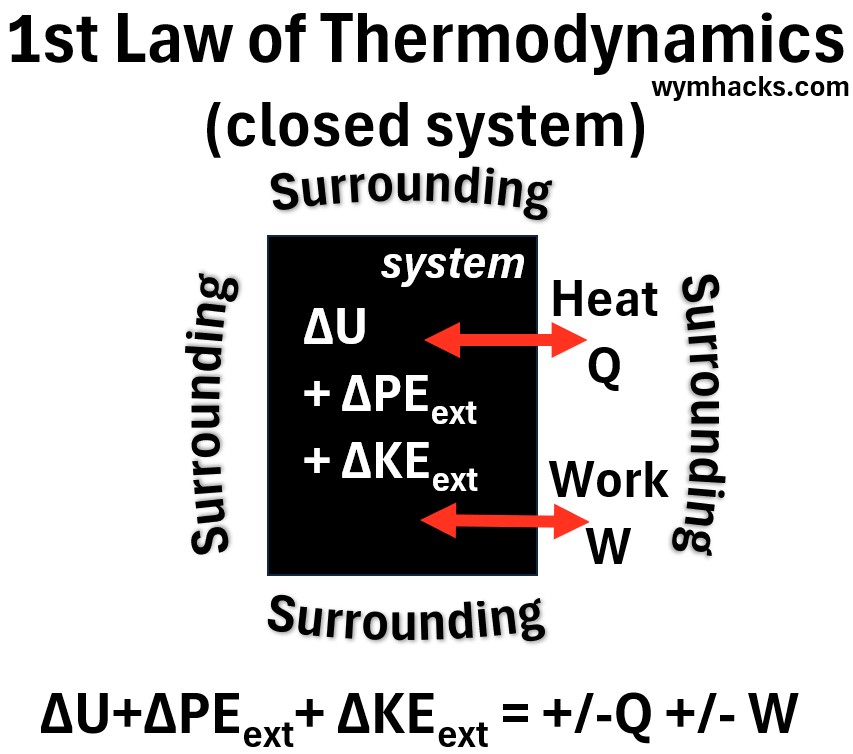
Then we can start with equation (17) and state
The First Law of Thermodynamics for a closed system as:
(18) ΔEtot =ΔΣKEint +ΔΣPEint +ΔKEext +ΔPEext = +-Qnet+- Wnet (closed system)
where
- energy units in the SI system are joules (J)
- Δ indicates a finite change
- Qnet and Wnet are the (cumulative) net heat and work being added or subtracted from the system.
- A (+) means Q or W is being added to the system (work done to or on system).
- A (-) means Q or W is being subtracted from the system (work done by system).
I think its clear and logical to use the +/- signage on the right hand side to indicate energy entering (+) or leaving (-) the system.
Sadly, the most common convention is to show the right hand side as Q – W where +W is interpreted as work being done by the system.
The conventional way is just confusing and and non-intuitive.
It makes more sense to
- Write the right hand side as Q + W
- then assign the + or – to the Q or W depending on whether its being added (+) or subtracted (-).
- Any energy or work entering the system will increase the system energy and so should be a positive.
- Any energy or work leaving the system will decrease the system energy and so should be a negative.
- Ill call this the MMS method.
For example, in the conventional system, the required thinking if you have work being done on the system is:
- +W is work done by the system, so work done on the system is -W
- then I must plug it into Q – W = Q–W = Q + W (right result but circuitously derived.
- Whereas if I use the MMS method, I know work is being done on the system so it has to be positive.
- So, Q + W is the right set up….done.
Ok, thanks for letting me rant a little.
Back to the equation. Take (18) and
- substitute for U (the internal PE and KE terms)
You get,
(19) ΔEtot = ΔU + ΔKEext + ΔPEext = +-Qnet+- Wnet (closed system)
Take (19) and
- assume that the system is stationary and the system PEext is negligible.
You get,
(20) ΔU = +-Qnet+- Wnet (closed system; negligible external PE and KE)
or if we understand that Q and W are the culmination of all the work and heat
(21) ΔU = +-Q+- W (closed system; negligible external PE and KE)
where +- indicate whether energy from Q and W are either
- increasing (+) the system energy or
- decreasing (-) the system energy
Conventionally you will see (21) written as
(22) ΔU = Q – W (closed system; negligible external PE and KE)
where
- Q = heat added to the system
- W = Work done by the system
Remember that these equations apply only to closed systems where no mass is moving in or out.
The Right Hand Side
The right hand sides of equations (21 or 22) involve energy in transit across the system boundary.
Q and W are not instantaneous properties of the system or surroundings.
They are energy moving into or out of the system boundary resulting in a quantity that accumulates or dissipates over time.
These kind of functions are called Path Functions
- as opposed to the Left Hand Side of the equation
- which involves State or Point functions.
A few more comments on heat…
Heat
Heat (Q) is defined as the
- transfer of energy between a system and its surroundings
- due to a temperature difference.
In the 1st law equations above, Q is the
- heat done by the system on its surroundings (-Q), or
- heat done by the surroundings on the system (+Q).
Its important for you to understand that heat is not temperature.
- Heat Q is energy in transit due to a temperature difference.
- Temperature is the driving force for the transfer of energy as heat.
- The amount of heat transferred is a function of the heat capacity C (specific heat) of a substance and the temperature difference
- dQ = mCdT , where m is mass, C is specific heat, and T is temperature range
- Q=mC(T2−T1) , when the specific heat capacity (C) of the substance can be considered constant over the temperature range being considered.
- Temperature is a State or Point function.
- It is an instantaneous property (like U).
- Heat is a quantity and depends on the path taken (Path Function).
- Heat is energy in transit which takes time and results in the accumulation or loss of energy.
- The result of heat transfer is a change in the internal energy of the system (which manifests as changes in the kinetic and/or potential energies of the molecules within the system)
When you are holding a cup of warm water, the warmness is a property of the system that is described by temperature.
- This cup of water does not have a heat. It has a temperature.
- The transfer of heat might have caused that temperature but the warmness you feel is the temperature.
Work
on the right-hand side of the First Law of Thermodynamics represents
- work done by the system on its surroundings (-W), or
- work done by the surroundings on the system (+W).
- It is a transfer of energy across the system boundary
- due to a macroscopic force acting through a distance.
This work can exist in various ways. Some examples are:
- Boundary work (PV work): When a gas expands and pushes a piston, it does work on the surroundings.
- Force * distance
- = Force * Volume/Area
- = Force/Area * Volume
- = Pressure* Volume
- = PV work
- Shaft work: A rotating shaft delivering power out of or into the system.
- Electrical work: Current flowing through a resistor in the system, or a motor within the system doing work on an external load
- Other work
Remember that we are expressing all the components of the First Law in units of energy (Joules in the SI system: Système International d’Unités, which translates from French to the International System of Units).
Return to Menu
State and Path Functions
I’ve mentioned this a few times but it’s worth repeating.
There are two distinct types of terms listed in the 1st Law of Thermodynamics equation.
- State (Point) terms (or variables or functions) and
- Path terms or (variables or functions)
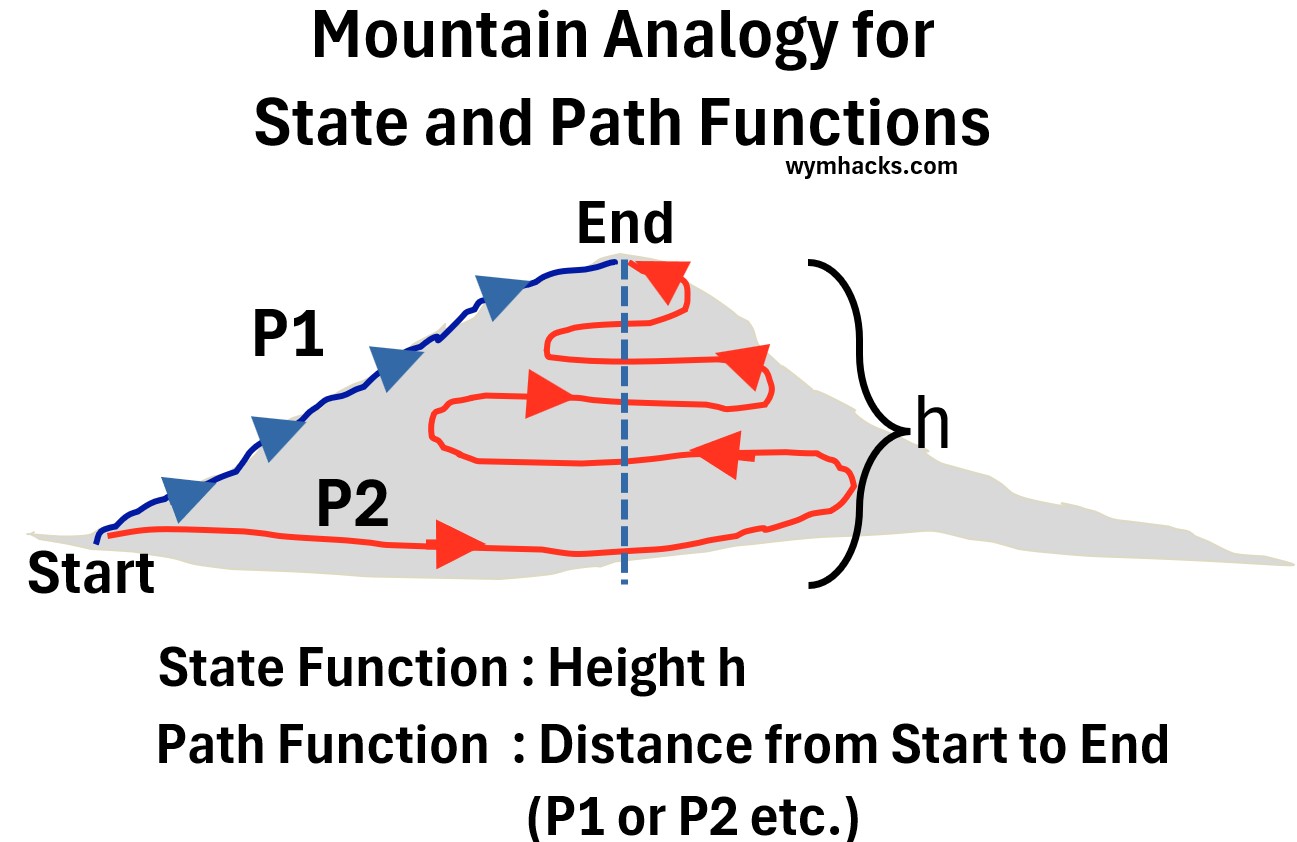
Consider the mountain analogy picture below as you read this section.
Picture: State and Path Functions Mountain Analogy
Recall the 1st Law equation in its full form
(19) ΔU + ΔKEext + ΔPEext = +-Qnet+- Wnet (closed system)
The terms on the Left hand side (U and the macroscopic movement and position energies of the system as a whole)
- are State (or Point) Functions
- U and the external energies are instantaneous properties of the system.
- They are instantaneous indicators of the state of the system.
- They do not depend on the path taken to get to that point or condition or state.
- The height of the mountain is a State Function in the mountain analogy picture above.
The Work and Heat terms on the right hand side, however,
- are Path Functions.
- Q and W are energies in transit.
- They will accumulate or reduce in the system over time.
- i.e. they are not instantaneous and depend on the path taken.
- There is no instantaneous condition or property called heat or work.
- The P1 and P2 routes in the mountain analogy picture above produce path functions
- The distance or energy expended to get to the top are path functions
- They will be different depending on whether route P1 or P2 is taken.
The distinction between state and path functions is
- crucial for applying thermodynamic laws,
- calculating energy changes, and
- understanding the efficiency of processes.
Steady State Flow Process
Consider a steady state flows process as depicted in the picture below where
- conditions within it are constant at all time (steady state) and
- there is no accumulation of mass or energy in the system
Picture: Steady State Flow Process
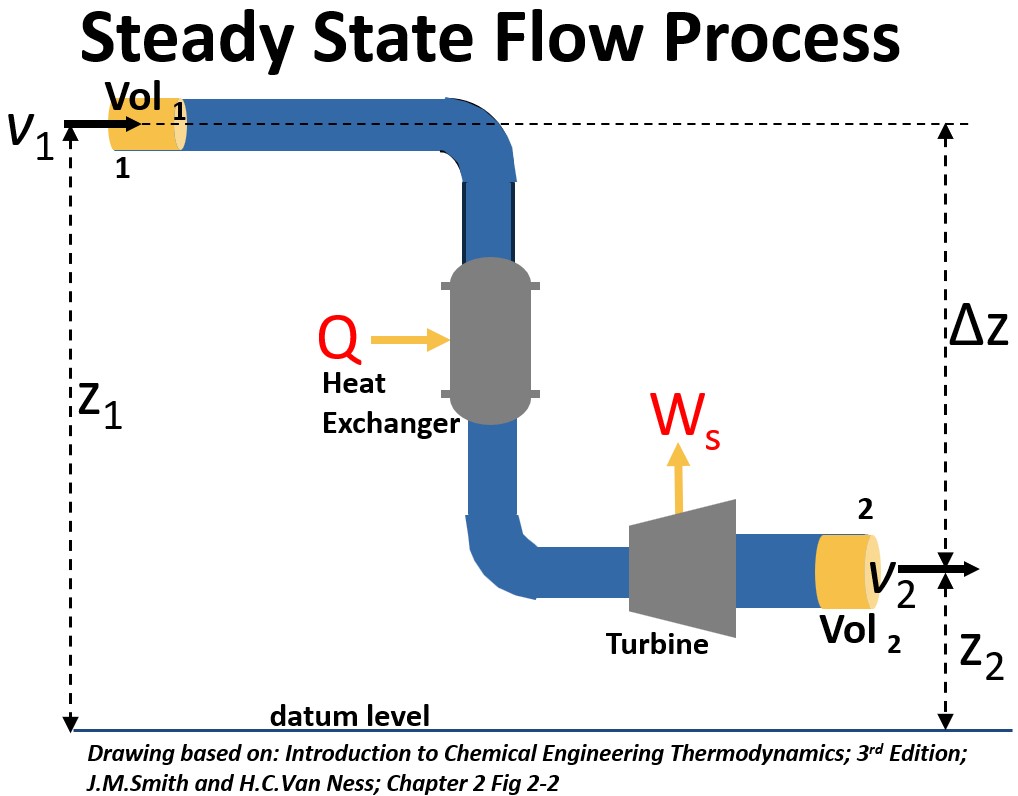
In the diagram above, a fluid flows from the entrance at 1 to the exit at 2.
- A unit of mass m is flowing (for example 1 kg/s or 1 lb/hr mass flow rate)
- Conditions at 1 are
- elevation from the datum level of z1
- velocity v1,
- volume V1,
- a pressure P1 and
- an internal energy U1
- Conditions at 2 are z2 , v2, V2, P2 , and internal energy U2
- m1 = m2 = m
Lets apply the First Law of Thermodynamics equation for closed (constant mass) systems:
(19) ΔU + ΔKEext + ΔPEext = +-Qnet+- Wnet (closed system)
Note: The variables Q and W represent absolute positive magnitudes. The physical direction of the energy transfer (into or out of the system) is explicitly dictated by the algebraic sign (+ or -) placed in front of them (for example +Q is heat into system and -W is work done by the system).
On a per mass basis (specific energy or energy per unit mass) equation (19) can be written as
(29) Δu + Δkeext +Δpeext = +-qnet+- wnet (closed system)
where all the terms represented in lower case are now in specific energy units i.e. energy/mass (e.g. J/kg).
The change in Kinetic Energy of the system from equation (9) is therefore
(30) Δkeext = ΔKEext /m = (1/2mΔ(v)/gc)(1/m)=1/2(v2-v1)/gc
where
- the proportionality constant gc is included for those who use English units (lbf and lbm).
The change in the Potential Energy of the system from equation (13) is therefore
(31) Δpeext = ΔPEext /m = (mg/gcΔz)(1/m) =g/gc(z2-z1)
where
- the proportionality constant gc is included for those who use English units (lbf and lbm) and
- h in equation (13) is replaced with z which is our symbol for height from the datum plane
We can substitute (30) and(31) into (29) and get
(32) Δu + 1/2Δ(v)/gc + g/gcΔz = +-qnet+- wnet (closed system)
where
- all terms are expressed on a mass basis (i.e. per unit mass i.e. specific energy e.g. energy/mass)
Thus far the expression applies to a closed system.
For a steady state flow process as depicted in the drawing above, we have to expand the work term.
There are two work types that are happening in a steady state flow system; pressure-volume work and shaft (more accurately; external) work.
- At the entrance boundary at 1, the fluid is effectively being pushed into the system boundary we’ve defined.
- So, at entrance 1, work is being done on the system.
- W1 = Force x distance = (F)(Volume 1)/(Area 1) = (F)(V1/A1)= (F/A1)(V1)= +P1V1
- w1 = work per unit mass or specific work = P1V1/m = P1v1
- v1 is volume per unit mass or specific volume
- And, at exit 2, work is being done by the system on the surroundings.
- W2 = Force x distance = (F)(Volume 2)/(Area 2) = (F)(V2/A2)= (F/A2)(V2)= -P2V2
- w2 = work per unit mass or specific work = -P2V2/m = -P2v2
- v2 is volume per unit mass or specific volume
- We can designate the second kind of work, done by the mechanical turbine (or pump or other), as the shaft Work being done on the surroundings or on the system = – Ws or +Ws
- and we’ll define ws = Ws/m = specific shaft work (work per unit mass).
Regarding “Shaft” Work
We have designated the turbine work as the shaft work in our example. But this term generally applies to any external work (spinning, shaft, electrical).
- So when you see the term Ws (or ws), it really applies to all external work (all work that doesn’t include the PV work).
Let’s put these work terms into equation (32).
(33) Δu + 1/2Δ(v)/gc + g/gcΔz = +-q + P1v1 – P2v2 +- ws
Move the Pv terms to the left hand side.
(34) Δu + P2v2– P1v1 + 1/2Δ(v)/gc + g/gcΔz = +-q +- ws
Express the Pv terms as a Δ (change) expression.
(35) Δu +Δ(Pv) + 1/2Δ(v)/gc + g/gcΔz = +-q +-ws
Now let’s convert the enthalpy equation (24) into a specific energy form:
(24) ΔH = ΔU + Δ(PV)
Dividing each side by mass m we get,
ΔH/m = ΔU/m + Δ(PV)/m
or
Δh = Δu + Δ(Pv)
where h, u and v are enthalpy, internal energy, and velocity expressed on a per mass (or specific) basis.
Substitute this into equation (35).
(36) Δh + 1/2Δ(v)/gc + g/gcΔz = +-q +-ws (1st Law, Steady State flow process)
For many (but not all) applications the kinetic and potential terms can be assumed to be zero. So,
(37) Δh = +-q +-ws (1st Law, Steady State flow process; negligible KE and PE)
- here Δh and q and ws are expressed on a energy/mass basis (e.g. btu/lb or kJ/kg)
- where + indicates heat to or work done to system
- and – which means heat from or work done by system
- e.g. +q is heat added to system and -ws is work done by the system.
If we multiply both sides of (37) by the actual mass flow rate ṁ (e.g. kg/s or lb/hr) we can express (37) as
(38) ṁΔh = +-ṁq +-ṁws
or
(39) ΔḢ =+-Q̇ +-Ẇs
where Ḣ, Q̇, and Ẇs are now expressed in terms of energy rate i.e. energy/time (e.g. kJ/s or btu/hr)
and ṁ is the mass rate (e.g. kg/hr or lb/hr)
Equations (37) and (39) are commonly used in industry when dealing with steady state flow of fluids through equipment (like a home ac refrigeration system)
Appendix 1: Defining H (Enthalpy) Using a Closed, Isobaric (Constant Pressure) System
Enthalpy has a universal definition but it can be derived using the following thought experiment:
Imagine a cylinder filled with an ideal gas, fitted with a frictionless, movable piston.
As we add heat, the gas expands, lifting the piston.
- At the start, the gas is at a lower temperature and volume, and its internal pressure perfectly balances the downward pressure of the atmosphere and the piston’s weight.
- When you add heat, the temperature (T) rises, causing the gas molecules to speed up.
- This creates a momentary pressure spike that pushes the piston upward, increasing the volume (V).
- At the end of the process, the piston comes to rest at a new, higher position.
- Because the piston is free to move, the internal pressure drops back down to exactly match its original value.
- According to the Ideal Gas Law (PV=nRT), since the pressure (P) is constant and the temperature (T) increased, the volume (V) must increase proportionally.
- You finish with a hotter gas taking up more space, but at the exact same pressure as the start.
Picture: Piston Cylinder System Constant Pressure Process
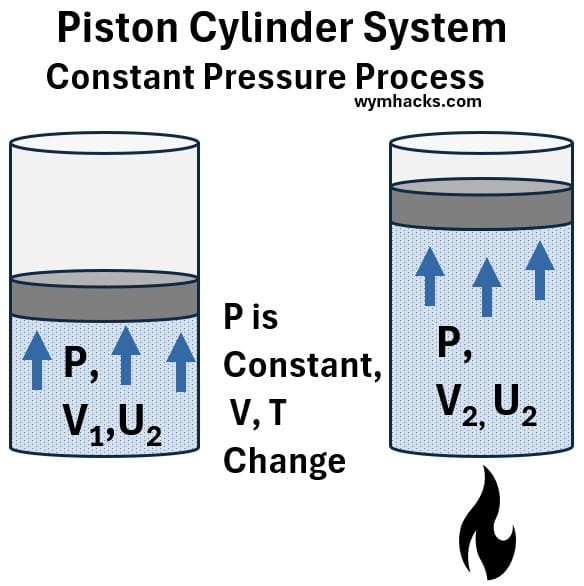
In this closed system, we apply the First Law of Thermodynamics:
So let’s start with equation (22) in the main text which we will number (1.1) for this appendix.
(1.1) ΔU = Q – W (1st law, closed system, negligible external PE and KE)
or
(1.2) Q = ΔU + W
(1.3) W = Force x distance = F x d = (F)(d)
Let’s convert the work equation into terms of volume and pressure.
(1.4) Pressure = P = Force/Area = F/A
(1.5) F = (P)(A)
Substituting 1.5 into 1.3:
(1.6) W = (F)(d) = (P)(A)(d)
but (A)(d) is the piston displacement which equals the cylinder volume change = ΔV.
Substituting back into (1.6) we get
(1.7) W = PΔV = P(V2 – V1)….Isobaric Process
Substitute (1.7 ) into the first law (1.2):
Now, rearrange the terms to group the final state variables together and the initial state variables together:
(1.10) Q = (U2 + PV2 ) – (U1 + PV1 ) Isobaric Process
The specific grouping, (U + PV), appears naturally in our math.
We define this grouping as Enthalpy (H).
(1.11) H = U + PV (Definition of Enthalpy. Always True)
For this specific isobaric process:
(1.12) Qconstant P = H2 – H2= ΔH Isobaric Process
Enthalpy is a Universal State Property
While we used an isobaric process to “discover” Enthalpy, Enthalpy is a universal state property.
It is not restricted to constant-pressure processes, just as Temperature or Pressure are not restricted to them.
Enthalpy (H) is defined for any substance, at any state, as:
(1.11) H = U + PV
Because U, P, and V are state functions (they depend only on the current state of the substance), Enthalpy is also a state function.
- For ALL processes: H = U + PV
- It is always a valid property that you can look up in a table for any fluid, regardless of the process path.
- In an Isobaric process: Q = ΔH (a special, simplified case where Enthalpy reveals the heat transfer).