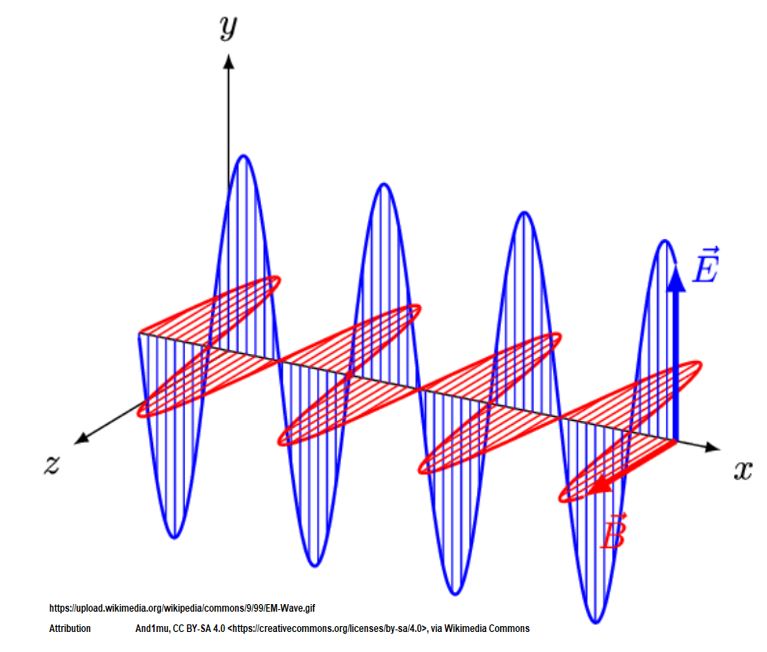
Electro-Magnetic Radiation
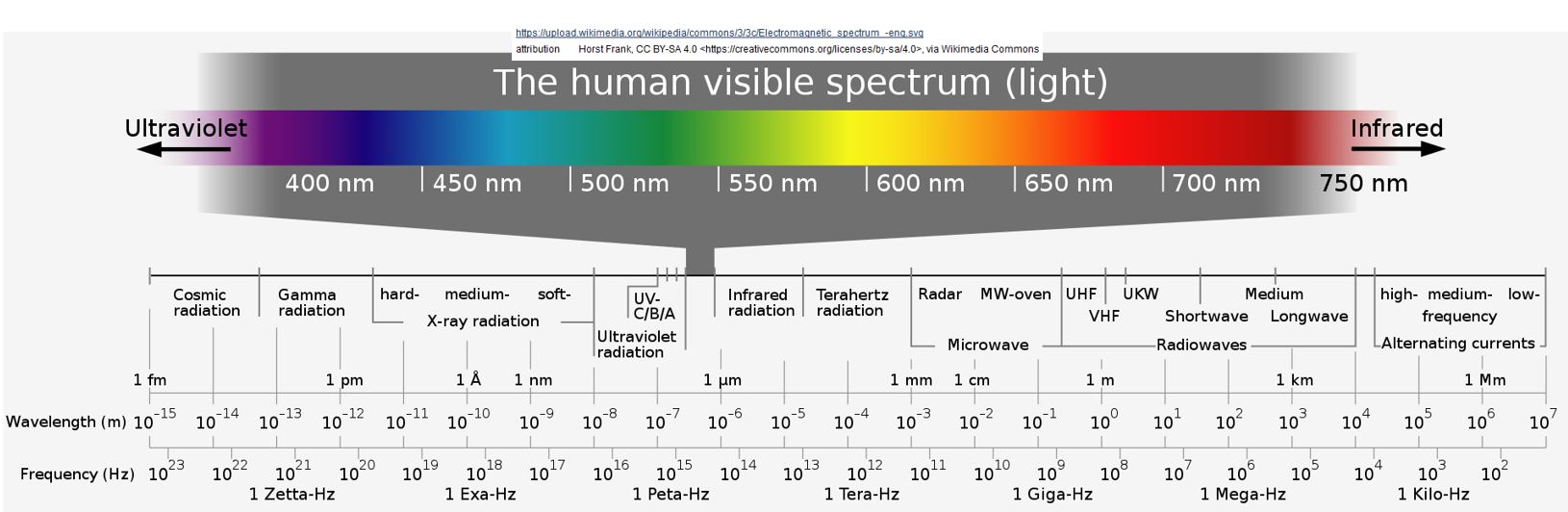
The human visible spectrum of light represents a small section of the full range of light which is called the Electro-Magnetic (Electromagnetic) Spectrum (EMS).
The EMS, in-total, can be described as Electro-Magnetic (Electromagnetic) Radiation (EMR).
In the graphic below you can see that visible light represents only a small portion of the full EMS (ranging from roughly 400 nanometers of wavelength to about 750).
- A mnemonic for memorizing the colors from longest wavelength to shortest is ROYGBIV (Red, Orange, Yellow, Green, Blue, Indigo, Violet)
- A mnemonic from short to long wavelength color is VIBGYOR
Picture1 – Electromagnetic Spectrum
Picture2 – Electromagnetic Spectrum
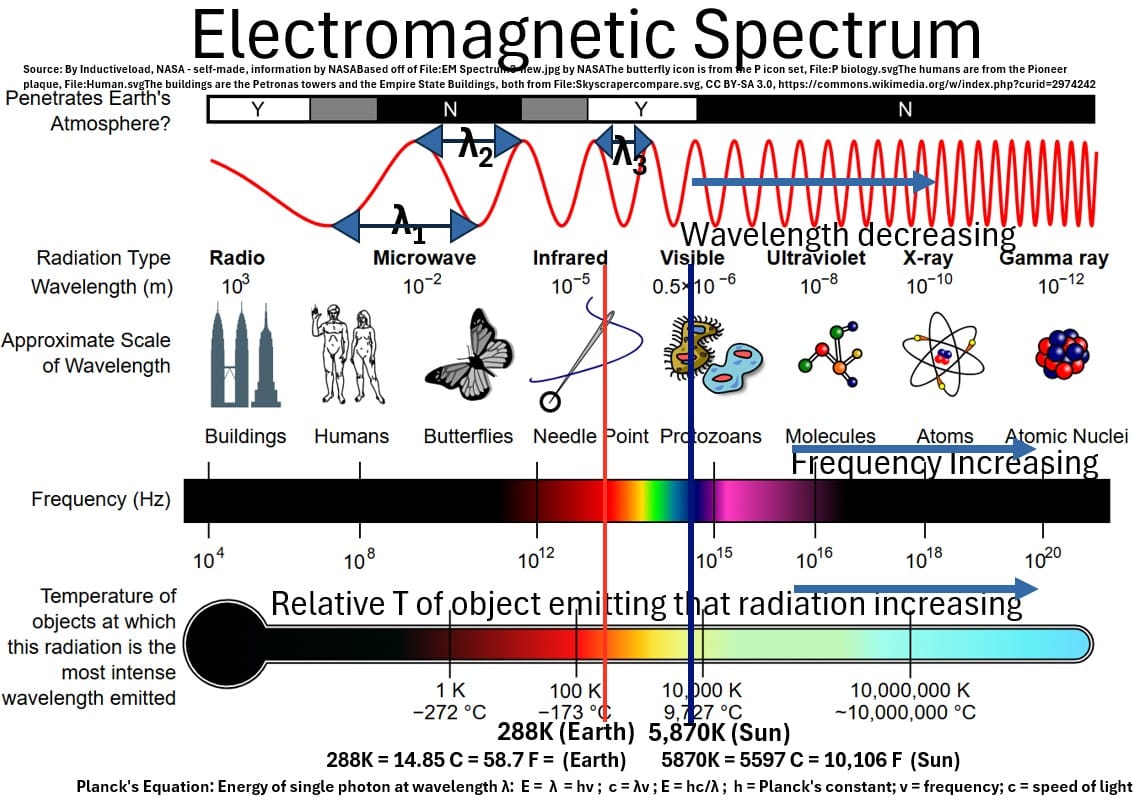
Note in the picture above how as lambda gets smaller (λ1 to λ2 to λ3) the frequency (the number of wavelengths counted in one second ie Hertz = cycles per second) gets bigger.
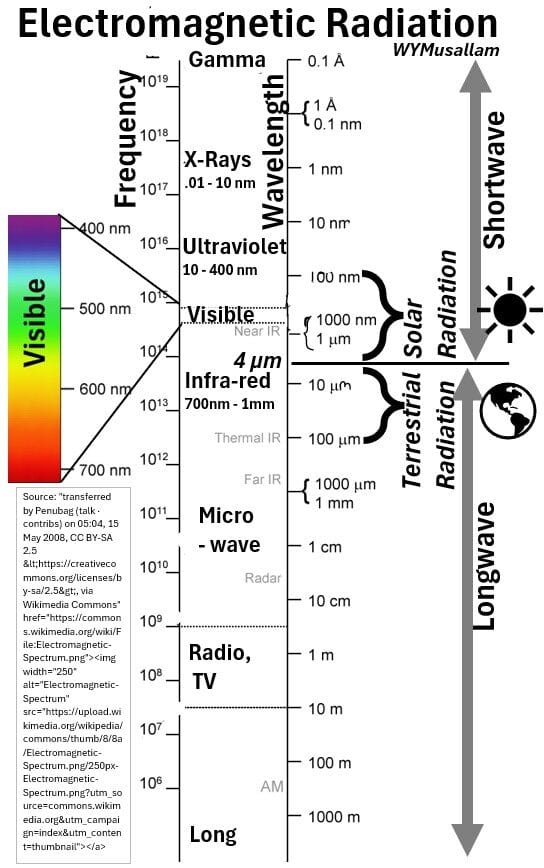
Picture3 – Electromagnetic Spectrum (Vertical View)
EMR Has Important Characteristics
- Electro-Magnetic (electromagnetic) Radiation, EMR, is radiation energy which travels in the form of electro-magnetic (electromagnetic) waves.
- EMR is (mathematically) both a wave and a particle (a photon, a massless unit of energy).
- Electro-Magnetic (Electromagnetic) Radiation, EMR, has oscillating electric and magnetic fields
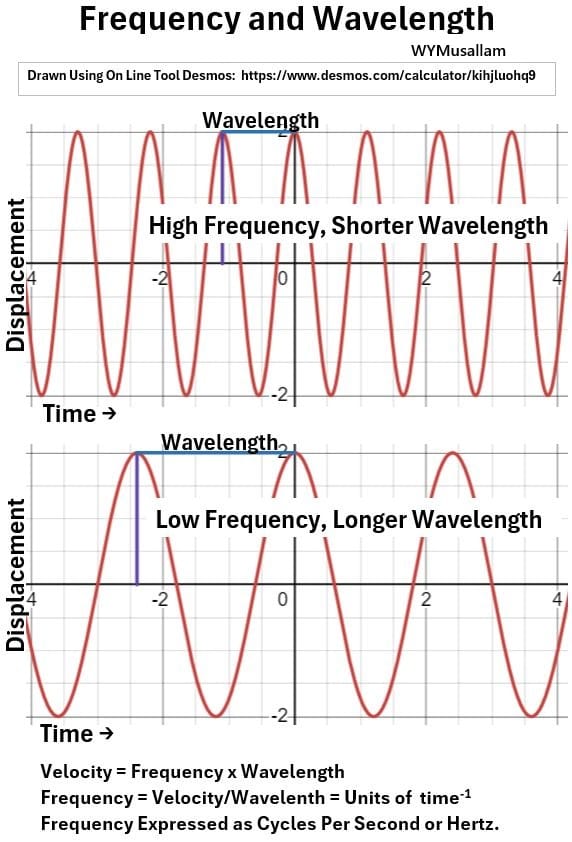
- As a wave, EMR has a wavelength (denoted with lambda λ; crest to crest or trough to trough distance) and frequency (denoted as nu ν; number of waves passing a point per unit time).
- Speed of light c is fixed and equals wavelength x frequency: c = λν
- Each photon at a certain wavelength will have a unique energy defined as E = hν: Planck’s Equation
- Substituting for v, E = hc/λ ; Planck’s Equation
- High frequency means lower wavelength and vice versa
- Higher frequency means higher energy
- Higher or larger wavelength means lower energy
- From picture2 above you can see that relative temperature associated with a body that is emitting that radiation increases with increasing frequency ν and decreasing wavelength λ.
Picture4 – Frequency and Wavelength
- The earth’s average surface temperature is about 14.85 C = 58.7 F = 288 Kelvin. It is an infrared wave radiator.
- The sun’s average surface temperature is 5597 C = 10,106 F = 5870 K. It is a UV, Visible, and Infrared wave radiator.
- In climate science a demarcation of about 4 microns wavelength is used to define shortwave radiation (or solar radiation) from longwave radiation (or terrestrial radiation).
- The sun’s electromagnetic radiation range covers UV 7%, Visible 44%, Infrared 49% with 95% of energy coming from wavelengths between .25 and 2.5 microns.
- For earth virtually all the radiation is infrared. Over 95% of Earth’s radiation has a wavelength between 2.5 and 25 microns.
- These waves can travel through a vacuum (it doesn’t need a medium like sound would for example).
- EMR moves at the speed of light which is super fast (would go around the earth’s equator almost 7.5 times in one second). Nothing can go faster by the way.
- In a vacuum light travels at
- 299,792,458 meters/second
- 670,616,629 miles/hour
- 1,079,252,848.8 kilometers/h
- 186,282 miles/second approximately
Sunlight is mostly in the Infrared, Visible, and Ultraviolet parts of the electro-magnetic (electromagnetic) spectrum
- In the 1600s, Isaac Newton demonstrated that sunlight “contains” the visible spectrum by bending (refracting) light and then “recombining” light through a series of two prisms.
- By “contains” we mean: possesses the range of electro-magnetic (electromagnetic) wavelengths that we see as the rainbow colors.
- Newton probably coined the word Spectrum. It comes from the Latin for ghost , apparition or specter.
- Visible light has wavelengths between 400 and 750 nanometers.
- A nanometer or nm is 1 billionth of a meter.
- In the visible region,
- Violet light has the shortest wavelength (highest frequency) and
- Red light has the longest wavelength (lowest frequency).
- Color doesn’t exist outside our bodies.
- Electro-Magnetic (Electromagnetic) Waves are sensed and translated by our eyes and brains into colour.
- The Scot, James Clerk Maxwell (1831 – 1879), and the German, Heinrich Rudolph Hertz (1857 – 1894), did pioneering work in this area.